
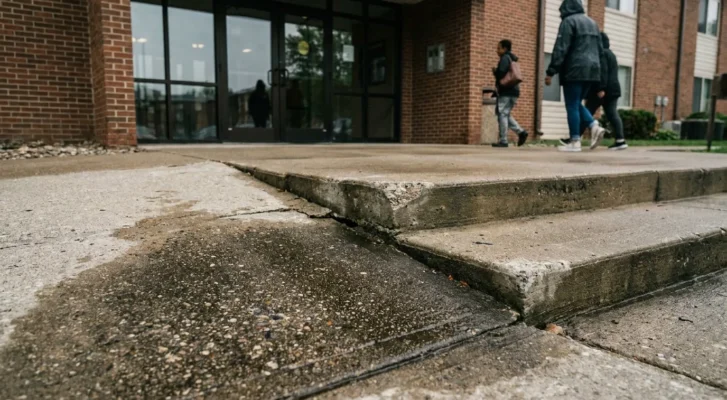
Who Is Responsible for a Slip and Fall at an Indianapolis Apartment Complex?
Understanding Liability When You Fall on Rental Property in Indianapolis
Key Takeaways: Responsibility for a slip and fall at an Indianapolis apartment complex rests with the party who controlled the property and failed to keep it reasonably safe, typically the landlord, property management company, or maintenance contractor. Under Indiana premises liability law, an owner is liable only when they had actual or constructive knowledge of a dangerous condition, should have expected visitors would not protect themselves, and failed to exercise reasonable care. Your fall must have been caused by a genuine hazard, and proving how long that hazard existed is often the most contested issue. Indiana’s modified comparative fault rule reduces your recovery by your share of fault and bars recovery entirely if you are 51% or more at fault. Strict deadlines include a two-year statute of limitations and tort claim notice requirements for government-related claims (180 days for political subdivisions, 270 days for the State). Preserving photos, incident reports, and maintenance records early is essential.
Responsibility for a slip and fall at an Indianapolis apartment complex generally rests with the party who controls the property and failed to keep it reasonably safe, most often the landlord, property management company, or maintenance contractor. In Indiana, that responsibility hinges on premises liability principles, comparative fault, and whether the owner knew or should have known about the hazard.
If you are dealing with mounting medical bills and lost income after a fall, the team at Poynter & Bucheri is ready to help. You can reach a knowledgeable Indianapolis injury attorney by calling (317) 406-7443 to discuss your situation.
Who Controls the Property and Owes You a Duty of Care
Duty of care is the starting point for every apartment slip-and-fall claim in Indiana. Property owners, occupiers, and those who control real estate have a legal obligation to make sure their premises are reasonably safe for guests, tenants, and visitors. At an apartment complex, this duty can extend to landlords, on-site property managers, and third-party maintenance or snow-removal companies.
Your legal status on the property shapes your protection. Tenants and their invited guests are generally treated as invitees, and under Indiana law a landowner owes an invitee a duty to exercise reasonable care for their protection. This is the highest level of duty recognized in premises liability. By contrast, a landowner owes a trespasser only a limited duty to refrain from willfully or wantonly injuring them after discovering their presence.
💡 Pro Tip: Identify every entity that may share responsibility early. A management company, maintenance vendor, and property owner can each carry insurance that may factor into a slip and fall claim Indiana residents pursue.
The Three Elements That Establish Landlord Negligence
Indiana courts apply a specific three-part test to decide whether a property owner breached the duty of care. Drawing from the Restatement (Second) of Torts § 343, as adopted in Burrell v. Meads, 569 N.E.2d 637 (Ind. 1991) and reaffirmed in subsequent cases, a landowner may be liable only when each element is present:
- The owner knew about, or through reasonable care would have discovered, the condition and recognized it posed an unreasonable risk of harm.
- The owner should have expected that tenants or visitors would not discover or protect themselves against the danger.
- The owner failed to exercise reasonable care to protect visitors from that danger.
All three elements must be satisfied for negligence to attach. Simply slipping is not enough; your fall must have been caused by a genuine dangerous condition on the property. You can read a helpful overview of these standards in this guide on proving fault in a slip and fall published by Nolo.
Proving the Owner Knew About the Hazard
Notice is frequently the most contested issue in premises liability Indianapolis cases. Under Indiana premises-liability law, a defendant must have actual or constructive knowledge of a condition that involves an unreasonable risk of harm to an invitee. Without that knowledge, the owner is generally not liable.
Constructive knowledge often turns on how long the hazard was present. Indiana courts have explained that constructive knowledge exists when a condition has existed for such a length of time that a reasonably careful owner would have discovered it in time to prevent injury. A puddle that appeared moments before your fall is treated very differently from one that sat unaddressed for hours.
Reasonable inspection routines can defeat a claim, which is why documentation matters. In one federal decision from the Seventh Circuit, evidence that an employee had visually inspected the area five to ten minutes before a fall and saw no hazards helped support summary judgment for the property owner. You can review the reasoning in the appellate court’s premises liability opinion involving a national retailer. This is why preserving photos, incident reports, and maintenance records early can be decisive.
💡 Pro Tip: Take date-stamped photographs of the hazard, your injuries, and the surrounding area before anything is cleaned or repaired. Maintenance logs and prior complaints about the same condition can help demonstrate the owner had notice.
How Indiana’s Comparative Fault Rule Affects Your Recovery
Indiana uses a modified comparative fault system that can reduce or eliminate your recovery. Under IC 34-51-2-6, an injured party who is found 51% or more at fault recovers nothing. If your share of fault falls below that threshold, your damages are reduced proportionally. Note that when a governmental entity is the defendant, Indiana instead applies contributory negligence, under which any fault by the injured person can bar recovery.
Insurers frequently use comparative fault to shift blame onto the injured person. A property manager’s insurer may argue that you were distracted, wearing improper footwear, or ignored an obvious warning. Because even a modest fault percentage lowers your compensation, and 51% erases it entirely, how the facts are framed carries real financial weight.
| Claimant’s Assigned Fault | General Effect on Recovery |
|---|---|
| 0%, 50% | Damages reduced by your fault percentage |
| 51% or higher | No recovery permitted under IC 34-51-2-6 |
Venue can also influence claim value. Settlement outcomes and jury behavior vary by county, and Marion County, which covers Indianapolis, has historically produced some of the state’s largest personal injury verdicts. For a deeper look at apartment-specific scenarios, this discussion of a slip and fall at an apartment complex offers useful background.
What to Do After You Say "I Tripped and Fell Flat on My Face"
The moments after a fall matter for both your health and potential claim. Seek medical attention promptly, because documented connection between the hazard and your injury supports causation. Report the incident to the property manager and request a written incident report for a contemporaneous record.
Timing is critical because Indiana imposes firm deadlines. Personal injury claims, including slip and fall cases, are subject to a two-year statute of limitations under IC 34-11-2-4, measured from the date of the accident. Missing that deadline can bar your claim entirely.
A different and shorter deadline may apply if your fall occurred on government-owned or government-operated property. Under the Indiana Tort Claims Act, formal tort claim notice is generally required within 180 days for claims against a political subdivision and within 270 days for claims against the State, before a lawsuit may be filed. This administrative requirement is strictly enforced and can apply to public housing or municipally operated grounds.
💡 Pro Tip: Do not give a recorded statement to an insurance adjuster before understanding your rights. Casual comments can later be characterized as admissions of fault under Indiana’s comparative fault framework.
Working with a dedicated advocate can help you preserve evidence and meet deadlines. If you need guidance from a seasoned slip and fall attorney Indianapolis residents rely on, an attorney can help investigate notice, identify responsible parties, and document your damages while the record is fresh.
Frequently Asked Questions
- Can I still recover if I was partly at fault for my fall?
Possibly, depending on your assigned percentage of fault. Under IC 34-51-2-6, you may recover if you are 50% or less at fault, though your damages will be reduced proportionally. If you are found 51% or more at fault, you generally cannot recover. Keep in mind that against a governmental entity, any degree of your own fault may bar recovery under Indiana’s contributory negligence rule.
- Who can be held responsible for an apartment complex fall?
Responsibility may fall on the landlord, property management company, or maintenance contractor, depending on who controlled the area. In some cases, more than one party may share liability for the hazardous condition.
- How long do I have to file a slip and fall claim in Indiana?
Most personal injury claims must be filed within two years of the accident under IC 34-11-2-4. If a government entity is involved, a tort claim notice may also apply before suit, generally 180 days for a political subdivision and 270 days for the State. Acting promptly is strongly advisable.
- What evidence helps prove landlord negligence in Indianapolis?
Evidence that shows the owner had actual or constructive knowledge of the hazard is most valuable. Photographs, incident reports, maintenance and inspection logs, prior complaints, and witness statements can help establish how long the danger existed and directly address the notice element Indiana courts require.
- Is simply slipping enough to win a case?
No, slipping alone does not establish liability. Your fall must have been caused by a dangerous condition, and you must prove the owner breached the duty of care and that the breach caused your injury. Establishing all three negligence elements is essential to a viable claim.
Moving Forward After an Apartment Slip and Fall
Determining who is responsible for a slip and fall at an Indianapolis apartment complex requires careful examination of control of the property, the owner’s knowledge of the hazard, comparative fault, and strict filing deadlines. Landlords and their insurers often resist these claims by disputing notice or shifting blame, which is why preserving evidence and understanding the governing statutes is important. With the right preparation, injured tenants and guests can pursue fair compensation for medical costs, lost wages, and pain and suffering.
If you are ready to protect your rights after an apartment injury Indiana claim, the attorneys at Poynter & Bucheri are prepared to review your case and explain your options. Call a trusted slip and fall lawyer Indianapolis families depend on at (317) 406-7443 to take the next step toward recovery.