
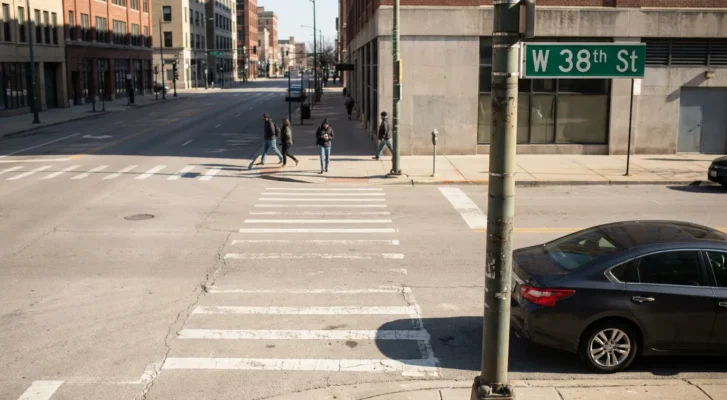
Foster Hill Killed on West 38th Street: How Attorneys Prove Driver Fault
Fatal West 38th Street Crash Renews Focus on Stroke After Car Accident Risks
Key Takeaways: A recent pedestrian fatality on West 38th Street has drawn renewed attention to how Indiana families pursue accountability after a deadly collision. Under Indiana law, only the estate’s personal representative may bring a wrongful death claim, and attorneys must first prove the driver’s negligence. Damages generally include medical, funeral, and burial expenses, along with the loss of a loved one’s companionship. A wrongful death action must typically be filed within two years, though exceptions are interpreted narrowly. This article also explains why survivors of nonfatal crashes should watch for delayed complications, including a stroke after car accident trauma. Every case turns on its specific facts, and outcomes are never guaranteed.
The death of Foster Hill on West 38th Street has become a sobering reminder of how quickly an ordinary walk can turn tragic in Indianapolis. Pedestrians face particular danger on busy urban corridors, where speed, distraction, and poor visibility can combine with devastating results. For grieving families, the aftermath raises hard legal questions about who can pursue a claim, how fault is proven, and what compensation the law allows. This report explains the negligence framework that governs a pedestrian fatality Indianapolis families may confront, and it addresses a related medical concern that often surprises crash survivors.

Indiana’s Wrongful Death Framework After a Fatal Crash
Indiana treats wrongful death claims as statutory rights, which means the governing rules come directly from the legislature rather than general common law. The controlling authority for most adult fatalities is found in Title 34 of the Indiana Code, the state’s civil law and procedure title. Because these statutes are jurisdiction-specific, they apply to a Marion County crash regardless of where the at-fault driver lives.
Under the general wrongful death provision, a personal representative may bring an action only if the decedent could have maintained a personal injury claim had they survived. In practical terms, that means attorneys must establish the same liability element, driver fault, that would apply in a nonfatal injury case. Indiana’s general wrongful death statute also directs that recoverable damages generally include reasonable medical, hospital, funeral, and burial expenses, and it applies when the decedent leaves a surviving spouse or dependents. A wrongful death action must ordinarily be commenced within two years, a deadline courts tend to enforce strictly and to which exceptions apply only in limited circumstances.
When the person killed is an unmarried adult with no dependents, a separate provision often controls how the case proceeds and how recovery is distributed. The adult wrongful death statute provides that only the personal representative may maintain the action, not individual family members acting on their own. That statute also limits certain damages, generally barring recovery for the adult decedent’s lost future earnings, while allowing recovery for medical and funeral costs and for the loss of the adult person’s love and companionship, with the latter category subject to a statutory cap. Which statute applies depends on the decedent’s age, marital status, and dependency status, so identifying the correct provision is a threshold step subject to the specific facts.
A Marion County Family’s Search for Answers
Imagine a daughter in Indianapolis who learns that her father was struck and killed while crossing a wide, high-traffic street near his home. In the days that follow, she faces funeral costs, unanswered questions about the driver’s conduct, and pressure from an insurance adjuster seeking a quick statement. She is not sure whether she, her siblings, or her father’s estate has the right to pursue anything at all.
This scenario reflects the confusion many families feel after a pedestrian struck by vehicle incident on a road like West 38th Street. Under Indiana law, she generally cannot file individually; instead, the estate’s personal representative would need to be appointed to bring the claim. Understanding that requirement early can prevent missed deadlines and preserve the family’s ability to seek accountability, though every situation depends on its own facts.
How Attorneys Build Proof of Driver Fault
Proving driver fault is the heart of any fatal-crash claim, and it rests on the familiar negligence elements of duty, breach, causation, and damages. Drivers owe pedestrians a duty of reasonable care, and violating a traffic law or driving inattentively can constitute a breach. Because Indiana follows a modified comparative fault approach in most cases, the way liability is framed can significantly affect recovery, which is why careful investigation matters from the outset.
Evidence That Establishes Negligence
Strong liability evidence generally comes from multiple sources gathered soon after the collision. Attorneys and reconstruction professionals often work to preserve proof before it disappears, because skid marks fade and surveillance footage is frequently overwritten within days. Families researching how attorneys handle this step can review a detailed guide on the evidence that proves crash fault in Indiana cases.
The most persuasive evidence in a West 38th Street crash claim may include the following categories. Each item can help establish negligence liability Indiana courts recognize, though the weight given to any piece of evidence depends on the circumstances:
- Police crash reports and officer observations at the scene
- Traffic camera, doorbell, or business surveillance video
- Event data recorder ("black box") information from the vehicle
- Eyewitness statements and 911 call recordings
- Accident reconstruction analysis of speed and impact angles
- Toxicology or phone-use records suggesting impairment or distraction
No single document decides a case, and defense insurers frequently dispute causation even when fault seems apparent. That is why building a layered record, rather than relying on one report, tends to strengthen a family’s position. Courts may consider all of this evidence together when weighing whether the driver breached the standard of care.
Who Can File and What Damages Apply
Only a court-appointed personal representative may pursue an Indiana wrongful death claim, and that person acts on behalf of the estate and statutory beneficiaries. In an adult case, medical, funeral, and burial expenses generally inure to the estate, while remaining damages benefit a surviving spouse, dependent children, or dependent next of kin. In certain situations under the adult wrongful death statute, the remainder may instead benefit a nondependent parent or nondependent child, depending on the family structure.
Indiana applies different statutes depending on the decedent, including a separate provision for the death of a child. The child wrongful death law allows a parent or guardian to bring an action against the party whose wrongful act or omission caused the death. Selecting the correct statute is fact-dependent, and the analysis can change based on age and dependency, so families generally benefit from early guidance.
Recognizing a Stroke After Car Accident and Other Delayed Injuries
Not every crash is immediately fatal, and some of the most serious harm develops in the hours or days after impact. A stroke after car accident trauma can occur when a violent jolt injures the arteries in the neck, a condition medical providers sometimes describe as a traumatic arterial dissection. Survivors and families should treat sudden headaches, slurred speech, dizziness, or weakness as a medical emergency, because prompt treatment can be critical.
Why Medical Documentation Matters
Delayed symptoms create both health and legal challenges, particularly when an insurer argues that a later condition is unrelated to the collision. Careful medical documentation linking the injury to the crash generally helps counter those disputes. When a stroke after car accident develops, physicians and retained medical professionals may be needed to explain the causal connection between the impact and the vascular injury.
Families dealing with catastrophic injuries or wrongful death often need help coordinating this proof, which overlaps heavily with the fault analysis in a fatal case. Readers seeking broader guidance can explore the firm’s overview of car accident injury representation for context on how these claims proceed. Because a stroke after car accident may not appear on the day of the crash, timely evaluation and record-keeping remain important, subject to the facts of each situation.
How Does This Impact Me?
What Does This Case Mean for My Family’s Claim?
A high-profile pedestrian fatality does not change the underlying law, but it highlights how Indiana’s wrongful death rules operate. If a loved one was killed by a driver’s negligence, the estate’s personal representative would generally need to bring the claim. The specific damages available depend on which statute applies and on your family’s circumstances.
Does This Change My Deadline to File?
Indiana generally requires a wrongful death action to be commenced within two years of the death. This civil deadline is distinct from any shorter tort claim notice deadline that may apply when a government vehicle or entity is involved. Courts interpret extensions narrowly, and no extension should be assumed to apply automatically.
Can I Still Recover if I Was Partly at Fault?
Indiana’s modified comparative fault system may still allow recovery even when a pedestrian bears some responsibility, depending on the percentage assigned. However, recovery is reduced in proportion to a claimant’s fault and is barred entirely once that share exceeds 50 percent; note that claims against a government defendant are instead governed by the stricter contributory negligence rule. How fault is allocated is highly fact-specific and often contested by insurers.
What Should I Do Next After a Serious or Fatal Crash?
Preserving evidence early and seeking prompt medical evaluation are generally two of the most important steps. Keeping records of expenses, avoiding recorded statements to the other driver’s insurer, and consulting a lawyer can help protect your options. These steps do not guarantee any result, but they can reduce the risk of losing key proof.
What Grieving Families Should Take Away
The loss of Foster Hill underscores how Indiana law channels accountability through a structured, statute-driven process. Families pursuing a wrongful death claim Indiana recognizes must identify the correct statute, act within the applicable deadline, and build persuasive evidence that a driver’s negligence caused the death. Survivors of nonfatal crashes should also remain alert to delayed complications and document them carefully. Because every claim turns on its own facts, the information here is general and not a substitute for individualized legal advice.
If your family has been affected by a fatal or serious collision, understanding your rights early can make a meaningful difference. The team at Poynter & Bucheri works with injured people and grieving families across Marion County and throughout Indiana. To discuss your situation, you can call [(317) 406-7443]((317) 406-7443) or contact us today to learn more about your options.