
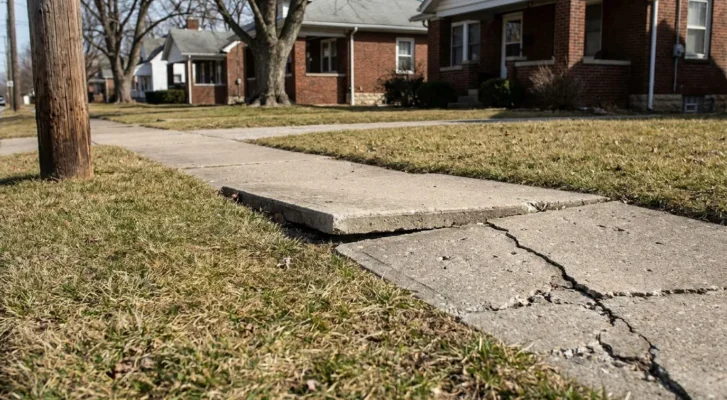
Does ASTM F1637 Cover Trip Hazards and Uneven Walkways in Indiana?
Uneven Sidewalks in Indianapolis: What a Walkway Standard Can and Cannot Do for Your Claim
Key Takeaways: ASTM F1637 addresses trip hazards but is a private standard, not Indiana law. Indiana Code Title 34 does not adopt it, so compliance is evidence of reasonable care rather than automatic negligence. Invitee claims follow Restatement (Second) of Torts § 343, adopted in Burrell v. Meads, requiring proof the owner knew or should have known of the hazard and failed to exercise reasonable care. Indiana’s modified comparative fault statute, IC 34-51-2-5, reduces recovery by your fault percentage; IC 34-51-2-6 bars recovery when fault exceeds fifty percent. City sidewalk falls follow the Indiana Tort Claims Act, IC 34-13-3, with strict notice deadlines shorter than civil statutes of limitations.
ASTM F1637 is a private standard addressing trip hazards. It does not create Indiana law. Falls on uneven sidewalks are evaluated under Indiana’s premises liability doctrine and statutory fault scheme, with the standard serving as evidence rather than a violated rule.
If an uneven walkway left you with a broken wrist, fractured hip, or mounting medical bills, the team at Poynter & Bucheri can help. Call (317) 406-7443 or reach out to our team today to discuss your options.
What the ASTM F1637 Slip Resistance Standard Actually Covers
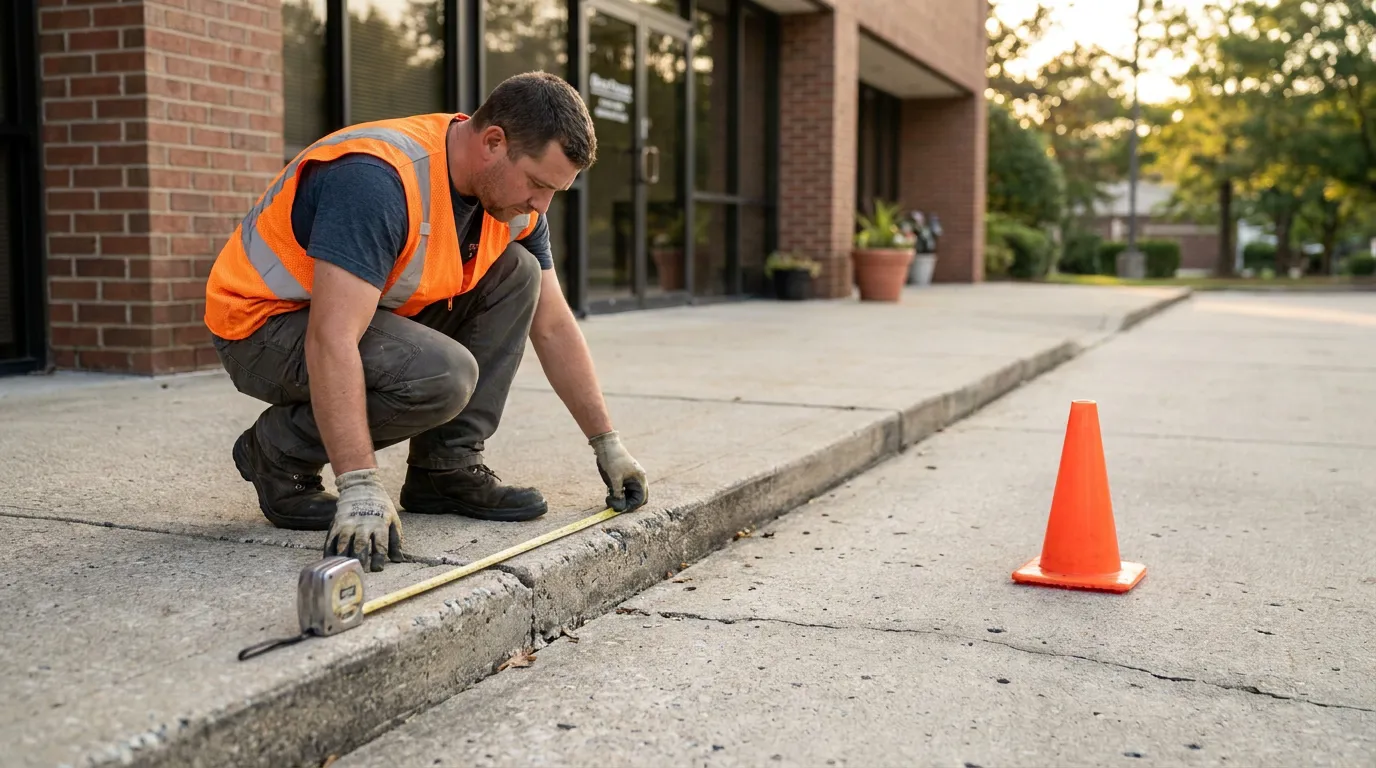
ASTM F1637 is a voluntary consensus standard addressing safe walking surfaces, including limits on abrupt level changes and surface irregularities. Safety engineers and property professionals commonly reference it when designing or inspecting walkways. In litigation, retained engineers often measure sidewalk defect heights and compare them to the standard’s criteria.
The key limitation matters enormously. ASTM F1637 was written by a private standards organization, not the Indiana General Assembly. Indiana Code Title 34, which governs civil law and procedure, reveals no adoption of ASTM F1637 as binding law. A property owner generally cannot be held negligent as a matter of law simply because a walkway fell outside the standard’s criteria.
Still, the astm f1637 slip resistance standard may carry real persuasive weight. Indiana courts permit evidence of industry customs and recognized safety practices to help juries decide whether a landowner acted reasonably. When an engineer testifies that a two-inch vertical offset far exceeds accepted criteria, that evidence can be compelling on breach. Compliance is evidence of reasonable care but not a complete defense.
The Indiana Legal Test That Actually Controls Your Trip and Fall Claim
Indiana applies the standard of care set out in Restatement (Second) of Torts § 343 to premises liability claims brought by invitees. As the Indiana Supreme Court reiterated in Isgrig v. Trustees of Indiana University, No. 24S-CT-158 (Ind. Apr. 22, 2025), quoting Burrell v. Meads, 569 N.E.2d 637, 639 (Ind. 1991), a landowner owes an invitee "a duty to exercise reasonable care for his protection." Store customers, restaurant patrons, and business visitors typically qualify as invitees.
Under § 343, an injured invitee generally must show three things. First, the owner knew of the dangerous condition or would have discovered it through reasonable care, and should have realized it involved unreasonable risk. Second, the owner should have expected invitees would not realize the danger or protect themselves. Third, the owner failed to exercise reasonable care to protect against the hazard. The plaintiff must also prove causation and damages.
This is where a walkway standard may become useful rather than decisive. ASTM F1637 criteria can help demonstrate that a surface irregularity was the kind of condition a reasonably careful owner should have discovered and corrected.
The Duty to Inspect Extends to Fixtures
Indiana’s reasonable care duty generally includes an obligation to reasonably inspect and maintain the premises. The Isgrig Court, citing Burrell, 569 N.E.2d at 639, confirmed this duty extends to the premises as a whole. For trip hazards, this may support an argument that maintenance includes periodically inspecting walkway surfaces for developing elevation changes.
Res Ipsa Loquitur After Isgrig
The Isgrig decision expanded evidentiary options for some injured plaintiffs. The Court held that res ipsa loquitur is not categorically unavailable in premises liability cases involving fixtures. Res ipsa generally requires that the instrumentality was under the defendant’s exclusive control and that the incident ordinarily does not occur absent negligence.
How Fault Sharing Affects an Indianapolis Trip and Fall Case
Indiana uses modified comparative fault, so being partly at fault does not necessarily end your case. Under IC 34-51-2-5, contributory fault "diminishes proportionately the amount awarded as compensatory damages" but does not bar recovery except as provided in section 6, which bars recovery when the claimant’s fault exceeds fifty percent. Insurers often argue that a person distracted by a phone or carrying groceries bears most blame for a sidewalk fall.
💡 Pro Tip: Photograph the elevation change with a coin, ruler, or shoe beside it on the day of the fall. Height differentials get ground down, patched, or replaced, and a measured photo is often the strongest surviving evidence.
When the Sidewalk Belongs to the City
Claims against governmental entities generally follow a different track. IC 34-51-2-2 provides that the comparative fault chapter "does not apply in any manner to tort claims against governmental entities or public employees under IC 34-13-3." Those claims proceed under the Indiana Tort Claims Act, where common law contributory negligence can still operate as a complete defense.
Notice deadlines under the Tort Claims Act are strict. Claims against a political subdivision such as a city generally require written notice within 180 days of the loss, while claims against the State generally require notice within 270 days. These administrative notice requirements are distinct from the civil statute of limitations for personal injury, which in Indiana is generally two years. If your fall happened on a public walkway, understanding liability for city sidewalk falls early is important, because missing a notice deadline can be difficult or impossible to cure.
| Type of Property | Governing Framework | Key Timing Concern |
|---|---|---|
| Private store, restaurant, or parking lot | IC 34-51-2 comparative fault | Civil statute of limitations |
| Apartment complex or commercial building | IC 34-51-2 comparative fault | Civil statute of limitations |
| City-owned sidewalk or public facility | Indiana Tort Claims Act, IC 34-13-3 | Tort claim notice plus limitations period |
Where Federal Accessibility Rules Fit In
The ADA Accessibility Standards are frequently cited alongside ASTM F1637 in trip hazard analysis. Unlike the voluntary consensus standard, the ADA accessibility standards hosted by the U.S. Access Board are enforceable federal design criteria for covered facilities. A walkway at a covered facility that fails enforceable federal design criteria may support a stronger breach argument than one merely departing from a private standard, though the ADA does not create a private right of action for money damages for personal injury.
Why Trip Hazards Deserve Serious Attention
Falls are the leading cause of injury for adults ages 65 and older. According to CDC reporting, more than 14 million older adults report falling each year, with about 37 percent reporting an injury requiring medical treatment or restricting activity for at least a day.
Practical Steps After a Fall on an Uneven Walkway
Evidence in trip cases can disappear quickly, so early documentation may significantly affect outcomes. Property owners frequently repair defects within days, and surveillance footage may be overwritten quickly. Consider the following:
- Report the fall in writing and request a copy of the incident report.
- Photograph the defect from multiple angles, including close shots showing height differential.
- Capture surrounding lighting, drainage, and any warning signage.
- Preserve the shoes and clothing you wore without cleaning or repairing them.
- Seek prompt medical evaluation and keep every bill and work restriction note.
💡 Pro Tip: Send a preservation letter early. A written request that the property owner retain video, maintenance logs, and inspection records can meaningfully strengthen your position if those materials later go missing.
Working with an astm f1637 slip resistance standard lawyer can help you determine whether a safety engineer’s analysis is worth pursuing. Not every uneven walkway case requires retained testimony, and the value of a standards-based opinion depends on the measurements, location, and owner’s maintenance history.
Frequently Asked Questions
1. Is ASTM F1637 enforceable law in Indiana?
No, ASTM F1637 is a private consensus standard rather than an Indiana statute. Title 34 of the Indiana Code contains no adoption of it. Courts may permit the standard as evidence bearing on reasonable care.
2. How much of a height difference counts as a trip hazard?
There is no single Indiana statute setting a universal threshold for a sidewalk defect. Whether a particular offset was unreasonably dangerous is generally a fact question influenced by lighting, foot traffic, and how long the condition existed.
3. Can I still recover if I was not watching where I was going?
Possibly, because Indiana applies modified comparative fault under IC 34-51-2-5 to claims against private defendants. Your recovery would be reduced in proportion to your share of fault. Recovery is barred under IC 34-51-2-6 if your fault exceeds fifty percent.
4. Does the same process apply if I fell on a city sidewalk?
Generally no, because claims against governmental entities typically proceed under the Indiana Tort Claims Act, IC 34-13-3. IC 34-51-2-2 expressly removes those claims from the general comparative fault chapter, so common law contributory negligence may completely bar recovery. Shorter written notice requirements apply.
5. What if the property owner fixed the walkway right after my fall?
A subsequent repair does not necessarily prove liability, and Indiana Evidence Rule 407 generally limits using subsequent remedial measures to prove negligence. Photographs, witness accounts, and maintenance records created before the repair may still help establish the prior condition.
Putting the Standard in Its Proper Place
ASTM F1637 addresses trip hazards and uneven walkways, and it can be meaningful evidence in an Indiana premises liability case. It is not, however, the legal test. Your claim will turn on whether the evidence satisfies the § 343 elements as adopted in Indiana, how Indiana’s comparative fault statute allocates responsibility, and whether the defendant is a private business or governmental entity subject to separate procedures. Because these questions are fact-sensitive and deadlines can be unforgiving, an early case review is generally the most useful step.
If an uneven walkway or sidewalk defect caused your injuries, the attorneys at Poynter & Bucheri are ready to review the facts and explain your options. Call (317) 406-7443 or schedule a consultation now to get started.
Disclaimer: This content is for informational purposes only and is not legal advice. Every case is unique, and results may vary. Consult an attorney about your specific circumstances.