
What Injuries Can Pregnant Women Suffer in an Indianapolis Rear-End Crash?
How a Rear-End Crash Can Affect Pregnant Women
Key Takeaways: A rear-end crash during pregnancy can cause serious harm including placental abruption, preterm labor, miscarriage, whiplash, spinal injuries, abdominal trauma, and internal bleeding. The most dangerous complications often produce no immediate symptoms and may develop hours or days later, making prompt medical evaluation essential. National data confirm rear-end collisions injure occupants far more than they cause fatalities, and research suggests female occupants may experience crash forces differently. Proper seat belt positioning is a key protective measure for expecting mothers. Under Indiana law, injured victims can pursue compensation through a negligence claim, subject to a modified comparative fault system and a generally two-year statute of limitations, though a child born with injuries may have separate, longer deadlines.
A rear-end crash can put a pregnant woman and her unborn child at serious risk, even when the impact seems minor. The sudden force can cause injuries ranging from soft-tissue strain to placental abruption, and the most dangerous complications do not show symptoms right away. If you were rear ended while pregnant in Indianapolis, understanding these potential injuries and your legal options under Indiana law is essential for protecting both your health and your right to recover compensation.
Pregnancy changes how the body responds to crash forces. Expecting mothers face unique vulnerabilities, and even a low-speed impact may threaten the pregnancy in ways that are not immediately visible. That reality makes prompt medical evaluation and careful documentation essential for any pregnancy car accident Indiana claim.
If you or someone you love is dealing with the aftermath of a collision, the team at Poynter & Bucheri is here to help. Call us today at (317) 406-7443 or reach out through our contact page to discuss your situation.

Common Injuries Pregnant Women May Suffer in a Rear-End Crash
The abrupt back-and-forth motion of a rear-end collision can injure both mother and developing fetus. Outcomes depend on impact speed, gestational stage, and whether the occupant was properly restrained.
Below are injuries frequently linked to a pregnant rear-end collision Indiana crash:
-
Placental abruption, where the placenta separates from the uterine wall, threatening oxygen supply to the fetus.
-
Preterm labor or miscarriage, sometimes triggered by trauma or the body’s stress response.
-
Whiplash and spinal injuries, which may be aggravated by the added weight and posture changes of pregnancy.
-
Direct abdominal trauma, including from seat belt pressure during a sudden stop.
-
Internal bleeding or uterine injury, which may not produce obvious external symptoms.
Some of these conditions develop hours or days after the crash. Delayed symptoms are one of the most dangerous aspects of a fetal injury car crash Indiana scenario, because a mother may feel fine while a serious complication quietly progresses. That is why emergency evaluation and follow-up obstetric care are essential, even after a seemingly minor bump.
💡 Pro Tip: Always tell every treating provider that you are pregnant and that the injury followed a crash. Consistent medical records connecting your symptoms to the collision are critical if an insurer later disputes causation.
Why Rear-End Crashes Carry Real Injury Risk
Rear-end collisions are far more likely to injure occupants than to cause fatalities, making them a leading source of harm on the road. According to the National Safety Council, collisions between motor vehicles resulted in 43 percent of fatalities in 2024, yet accounted for 79 percent of injuries. That pattern underscores why occupants walk away from these crashes injured far more often than not.
Federal research confirms that occupant vulnerability is not the same for everyone. A U.S. Department of Transportation study, DOT HS 813 358, found that females have a higher estimated fatality risk than males in comparable crashes as front-row occupants, though that incremental risk is reduced in newer model-year vehicles. This supports the point that pregnant female occupants may experience crash forces differently and deserve careful, individualized medical assessment.
💡 Pro Tip: Keep your appointment records, discharge instructions, and fetal monitoring results in one folder. Organized documentation makes it easier to demonstrate the full scope of your Indianapolis auto accident injuries later.
Seat Belt Safety and Protecting Your Pregnancy
Proper seat belt use remains one of the most important protective measures for pregnant occupants. NHTSA data consistently show that unrestrained occupants are dramatically overrepresented among crash fatalities. Among passenger vehicle occupants killed in fatal crashes in 2023, roughly half were unrestrained compared to only a small fraction of survivors.
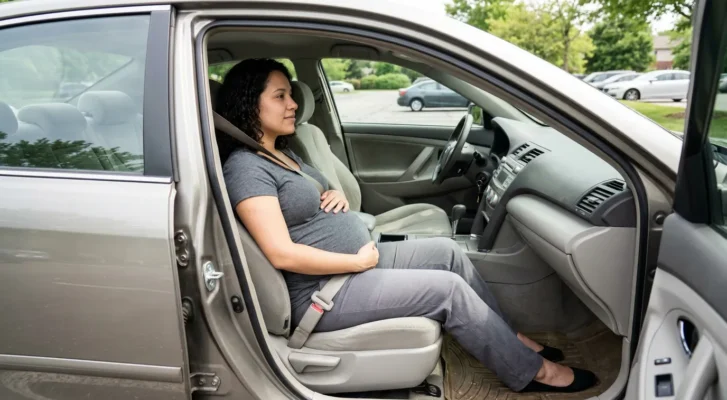
Expecting mothers should position the belt correctly rather than avoid it. The lap belt generally belongs low across the hips and under the belly, with the shoulder belt across the chest and to the side of the abdomen.
💡 Pro Tip: If a seat belt caused bruising across your abdomen during the crash, photograph it promptly. That evidence can help document the force involved and support your pregnancy crash claim Indianapolis.
Your Legal Rights After Being Rear Ended While Pregnant
Indiana law allows injured victims to pursue compensation from an at-fault driver through a negligence claim. Personal injury claims fall under Indiana’s civil law framework, codified in Title 34. To recover, a plaintiff generally must prove duty, breach, causation, and damages.
Indiana follows a modified comparative fault system that can affect how much you recover. Under the Indiana Comparative Fault Act, codified at Ind. Code § 34-51-2, a claimant’s recovery may be reduced by their share of fault, and a plaintiff whose fault is greater than 50 percent is generally barred from recovering. A claimant “must be 50% or less at fault to recover” while “51%+ fault = $0.” In a rear-end crash, the trailing driver is frequently found primarily at fault, though liability always turns on the evidence.
Deadlines matter, and missing them can end a claim permanently. Indiana’s personal injury statute of limitations is generally two years, codified at Ind. Code § 34-11-2-4, typically measured from the date of injury. Courts interpret exceptions narrowly, and you should not assume a deadline extension will apply automatically. Importantly, a child later born with injuries from the crash may have a separate claim whose deadline is generally tolled during minority, which is distinct from the mother’s own two-year deadline. As independent analysis notes, “Missing the deadline permanently bars your claim regardless of merit.”
Filing an insurance claim does not extend the court deadline for a lawsuit. The two run on different tracks, and keeping this distinction in mind can prevent a costly misunderstanding about timing.
How Compensation Is Valued in an Indiana Pregnancy Crash Claim
The value of an Indiana rear-end crash injuries claim depends on the severity of harm and the strength of evidence. Many settlements are estimated using a multiplier approach, where economic damages are multiplied by a factor reflecting injury severity. One widely cited method applies a number between 1.5 and 5 depending on how bad the injury is. Higher-severity pregnancy-related complications generally fall toward the upper end of that range, though no formula guarantees a particular outcome and actual settlements depend on the specific facts.
Legal representation tends to influence results. Data compiled from the Insurance Research Council suggest that represented claimants take home approximately 226% more than those who negotiate alone. You can review Indiana-specific negligence rules and settlement ranges through resources like this Indiana injury claim overview.
💡 Pro Tip: Do not accept an early insurance offer before your pregnancy reaches a stable point or your child is safely delivered. Some complications only become apparent later, and settling early may leave future costs uncovered.
Practical Steps to Protect Your Health and Your Claim
Taking the right steps early can strengthen both your recovery and your case. After a crash, prompt medical care protects you and your baby while creating the documentation an Indianapolis car accident attorney may later rely on. This guide on next steps after a pregnancy crash offers practical direction tailored to expecting mothers.
Building a strong claim often depends on preserving evidence. Photographs, the police report, witness contact information, and consistent medical records all help establish fault and causation. In serious cases, medical or accident reconstruction professionals may be retained to demonstrate how the crash caused the injury.
Choosing the right legal support can make a meaningful difference in an auto accident injury Indiana matter. Firms with extensive experience handling collision claims understand how insurers evaluate pregnancy-related injuries and how to counter attempts to minimize them. Learn more about how these matters are handled by visiting our car accident representation page.
Frequently Asked Questions
Can I file a claim if I feel fine after being rear-ended while pregnant in Indianapolis?
Yes, and you should still seek medical evaluation. Some pregnancy complications develop after the crash without early symptoms, so feeling fine does not rule out injury. Prompt care protects your health and documents any harm for a potential claim.
How long do I have to file a lawsuit after an Indianapolis pregnant driver crash?
Indiana’s personal injury statute of limitations is generally two years under Ind. Code § 34-11-2-4. Exceptions may apply in limited circumstances, but courts interpret them narrowly, and a child born with injuries may have a separate, longer deadline. Do not assume any extension applies automatically to your situation.
What if the crash was partly my fault?
You may still recover under Indiana’s modified comparative fault system. As long as you are 50 percent or less at fault, you can generally pursue compensation, though your recovery may be reduced by your share of fault.
What injuries should I watch for after the crash?
Watch for abdominal pain, bleeding, contractions, reduced fetal movement, or fluid leakage. These may signal placental abruption, preterm labor, or other serious complications. Seek emergency care immediately if any of these appear.
Do I need an attorney to handle a pregnancy car accident claim?
You are not required to, but legal help can be valuable in complex cases. Proving causation for pregnancy-related injuries and valuing future care can be challenging. An attorney can help preserve evidence and advocate for full compensation.
Protecting What Matters Most After a Crash
A rear-end collision during pregnancy can threaten both your well-being and your unborn child, making prompt action essential. From placental abruption to whiplash and delayed complications, the injuries linked to these crashes can be serious even when the impact appears minor. Understanding Indiana’s negligence rules, comparative fault framework, and filing deadlines helps you protect your right to pursue full and fair compensation.
If you have been injured, do not wait to get the guidance you need. Contact the team at Poynter & Bucheri Accident & Injury Lawyers today by calling (317) 406-7443 or scheduling a consultation online to learn how we can help you move forward with confidence.